

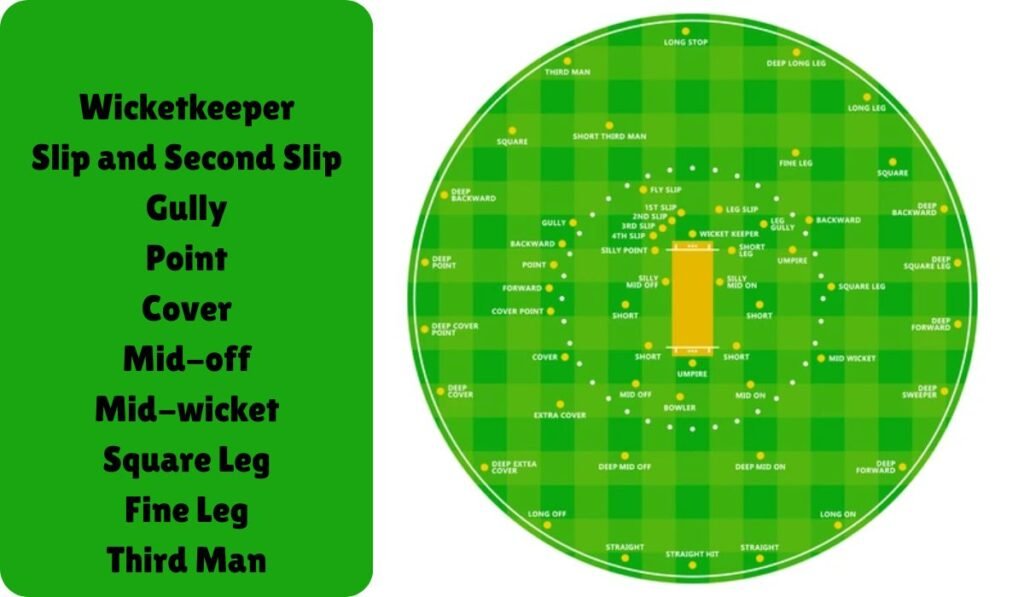

Cricket, a game in which strategy, skill and space are combined in an artful manner. Although many fans pay more attention to batting and bowling, learning the layout of a cricket field positions in cricket is equally important. Unlike other cricket books, Kirshenbaum is less concerned with the game on the field than the space it’s played out in – and for beginners to students to anyone seeking to kindle their fanaticism, understanding how a ground is designed and why players stand where they do will enhance your enjoyment.
Understanding the Cricket Ground Shape and Size
Cricket doesn’t have a set ground size like football or athletics. Cricket is widely played on a field with a grass surface, the perimeter of which should not exceed 200 yards. It’s cricket’s shape-shifting that sets it apart from global sports.
Diameter of Cricket Ground Typically, the diameter of a cricket ground is between 137 meters (450 feet) and 150 meters (500 feet). Some are more or less perfect circles; others oblong ovals. This variation regularly affects the way in which scoring occurs and in which sides arrange their fielding behaviour.
Cricket Field Positions: A Tactical Overview
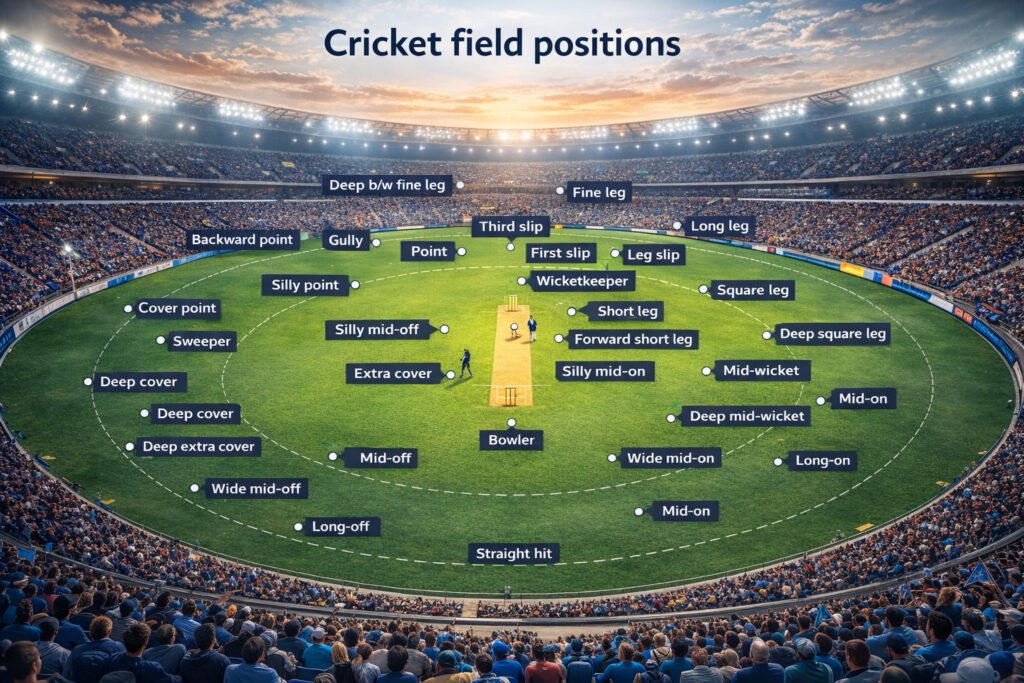
Some of the most common cricket field positions include:
- Wicketkeeper: Stands behind the batter to catch edges and attempt stumpings
- Slip and Second Slip: Positioned beside the wicketkeeper to catch fast edges
- Gully: Slightly wider than slips, ideal for catching rising balls
- Point: Covers square shots on the off side
- Cover: Protects the off side and stops powerful drives
- Mid-off: Positioned straight and close to the bowler
- Mid-wicket: Covers shots played on the leg side
- Square Leg: Stands square on the leg side
- Fine Leg: Positioned behind square to stop deflections
- Third Man: Covers edges that pass behind the slips
The Pitch: The Heart of the Cricket Ground
The pitch The central aspect of every cricket ground is the pitch, the most important part of the game. The pitch is a meticulously groomed run of closely cropped grass on which most of the action takes place – the bowling, batting and dismissals.
The pitch is a fixed field (unlike the outfield):
- Length: 20.12 meters (22 yards)
- Width: 3.05 meters (10 feet)
The state of the pitch – whether it is dry, green, or dusty – will have an impact on the game. Fast bowlers, spinners and batters are all advantaged in different ways according to pitch condition.
Read More: richest cricketer in the world 2026 | 1 to 100 jersey number in cricket india
Creases and Their Importance in Cricket
Curves are imaginary lines on the ground across which play is considered to be illegal. They are important for decisions on no-balls, run-outs and stumpings.
Popping Crease
A portion of a bowler’s foot needs to be resting behind this line when the ball is bowled. If it is crossed, the delivery is declared a no-ball, which becomes an advantage to the batting team.
Bowling Crease
It is the line at which wickets are set. The two bowling creases are set 20m apart as the official pitch length.
Batting Crease
That crease helps determine if a batter is safely inside his ground while running.
Wickets and Stumps Explained Simply
At each end of the pitch stands a wicket, and it is from here that most of the dismissals in cricket are effected.
- A wicket is a set of three wooden stumps and two wooden bails
- This are named off stump, middle stump and leg stump
- The overall height of the wickets is 71 cm
- The total width of the three stumps is 22.86 cm
In order to bowl a batsman out, the bails need to be removed from the stumps (by ball or via fielder’s throw).
Learn More: virat kohli water price 1 litre | most sixes in t20 international cricket
Players and Team Structure in Cricket
A cricket team is composed of 11 players. One team always bats while the other fields. The thing that strikes me about cricket is the authority given to the captain in the field.
Cricket field positions are placed by the captain in particular spots, and can be altered whenever needed according to the batter, bowler or match condition. There are 35 approved fielding positions, which have given the teams immense tactical options.
Why Cricket Field Positions Matter
It is sometimes said that cricket is a game of chess played out on grass, and here are some examples of why that’s certainly true: cricket field positions. Captains place fielders based on:
- The batter’s strengths and weaknesses
- The bowler’s style
- Type of match (Test, ODI or T20)
- Gameday (Runs defending or bowling for wickets)
A well-set field can develop pressure, invite mistakes and generate wicket-taking chances.
Final Thoughts
Understanding the size of a cricket ground, layout of the pitch and positions on field will enable you to see beyond runs and wickets. There is a reason for every line on the playing surface and every fielder’s position. Cricket is a game which takes you from the popping crease to fine leg boundary, a game of precision and planning.